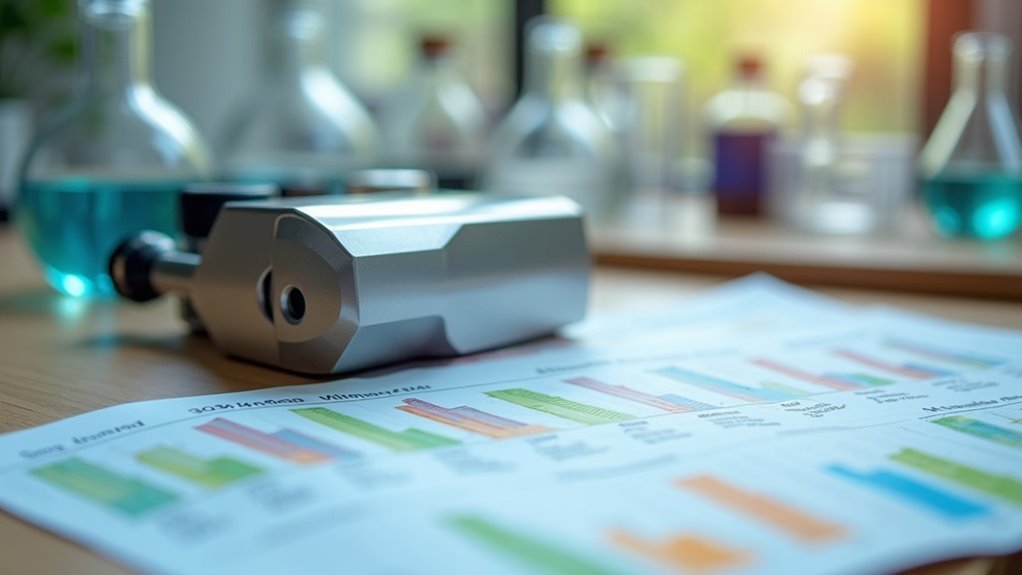
For precise measurements in your coffee brewing, consider utilizing high-quality refractometer conversion charts like the 10 Inch Circular Chart Recorder Paper and Honeywell Chart Paper. Both options offer clear data representation tailored for coffee enthusiasts.
Don’t overlook user-friendly tools such as the Kitchen Conversion Chart Magnet, which simplifies brewing measurements.
Additionally, the Brix Refractometer with ATC ensures accurate readings, essential for achieving the perfect brew.
With effective calibration standards like the Continuum Reagents, you can elevate your coffee brewing experience.
Explore other fantastic options available to enhance your brewing process even further!
10 inch Circular Chart Recorder Paper (100/Box)

If you’re looking for reliable and precise recording capabilities for your coffee brewing processes, the 10-inch circular chart recorder paper is your best choice. This high-quality paper comes in a pack of 100 sheets, ensuring you have plenty for all your coffee recording needs. With a uniform spacing of 0 to 100, it allows for clear data representation of your brewing parameters. It supports a 7-day recording capability, making it perfect for continuous monitoring of your coffee’s temperature and other essential variables. Compatible with popular chart recorders, including the Partlow model MRC 7000, this circular chart paper is versatile for any coffee enthusiast or professional. Plus, you’ll benefit from a universal 10-year guarantee, giving you peace of mind for your purchases.
Best For: This product is ideal for coffee laboratories and facilities that require consistent and accurate data recording over an extended period.
Pros:
- High-quality, durable paper that ensures reliable data representation for brewing.
- Supports a 7-day recording capability for continuous monitoring of coffee processes.
- Compatible with multiple chart recorder brands, including Partlow MRC 7000.
Cons:
- No specified units for the uniform spacing, which may lead to confusion in data interpretation.
- Limited to a 10-inch diameter, which may not fit all coffee recording setups.
- Requires specific chart recorders for optimal use, potentially limiting versatility in coffee applications.
Honeywell Chart Paper, Thermal, 12 (in), Blank with No Range or Time

For coffee aficionados who demand precise brewing results, the Honeywell Chart Paper, Thermal, 12 (in), Blank with No Range or Time is an essential tool. Designed specifically for Honeywell chart recorders, this thermal paper ensures clear and accurate data capture of your brewing processes without predefined ranges or times. Spanning 12 inches in diameter, it’s easy to use and compatible with various applications in the coffee-making world. While some users appreciate its reliability, others have mixed feelings about its price. Still, with an 18-month universal guarantee, this chart paper offers peace of mind for those who prioritize quality in their coffee data recording process.
Best For: Coffee professionals who require reliable and precise data recording for their brewing techniques.
Pros:
- Clear and accurate data capture without predefined ranges or times.
- Compatible with various applications, making it versatile for different coffee recording needs.
- 18-month universal guarantee, providing peace of mind regarding quality and reliability.
Cons:
- Mixed reviews on value for price, with some users feeling it’s expensive.
- Frustration among some users regarding the cost compared to alternatives.
- Limited options for temperature ranges and speeds, which may not suit all brewing needs.
Kitchen Conversion Chart Magnet – Extra Large Measurement Cheat Sheet

The Coffee Brewing Guide Magnet is the perfect companion for anyone who loves coffee, offering an extensive reference for all your brewing needs. Measuring 11 x 8.5 inches, it features bold, easy-to-read text that simplifies the coffee-making process. Whether you’re exploring different brew methods or measuring coffee grounds, this magnet covers it all, including brew times and water ratios. Its strong magnet ensures it stays firmly attached to your fridge, while the water-resistant surface makes cleanup a breeze. With a 4.8-star rating, it’s a must-have tool that enhances your kitchen’s decor and functionality. Grab one for yourself or as a thoughtful gift for the coffee lover in your life!
Best For: Anyone who enjoys coffee and needs a quick and reliable reference for brewing techniques and measurements.
Pros:
- Bold, easy-to-read text makes it simple to find brewing information at a glance.
- Water-resistant and easy to clean, ensuring it stays looking great in the kitchen.
- Strong magnet keeps it securely in place on your refrigerator for convenient access.
Cons:
- Some users wish for a slightly larger size for even better visibility.
- Only available in one color, which may not match all kitchen decor.
- Limited to brewing information, lacking additional coffee recipes or tips.
Brix Refractometer with ATC for Wine Making and Beer Brewing
Product not found or API error.
Designed specifically for coffee enthusiasts, the Brix Refractometer with Automatic Temperature Compensation (ATC) simplifies the task of measuring sugar content and specific gravity in your brews. This dual-scale tool measures Brix from 0-32% and specific gravity from 1.000 to 1.120, ensuring accurate readings. Its lightweight, durable construction makes it portable for various applications in coffee brewing and tasting. Users appreciate its straightforward functionality, eliminating the need for complex conversions. While it excels with coffee extracts, remember it’s not suitable for all liquids. With practice, you’ll master using it to calculate your coffee’s Total Dissolved Solids (TDS) effectively.
Best For: Coffee brewers and enthusiasts looking for an easy-to-use tool to measure sugar content and specific gravity in their beverages.
Pros:
- Accurate dual-scale measurements for Brix and specific gravity, ideal for coffee brewing.
- Lightweight and durable construction allows for portability and ease of use.
- Automatic Temperature Compensation (ATC) provides quick and reliable readings without complex calculations.
Cons:
- Calibration is specific to coffee extracts, making it less reliable for measuring other liquids like tea or juice.
- Some users report a learning curve for interpreting readings due to varying extraction methods.
- Minor complaints about robustness and lack of optical adjustment tools.
Continuum Reagents Refractometer Calibration Standard – Seawater Reference (60 ml)

Coffee enthusiasts and baristas seeking precise calibration will find the Continuum Reagents Coffee Brewing Calibration Standard particularly beneficial. This standard boasts a brew strength of 1.2% and a TDS of 1.5 g/L, making it ideal for calibrating your coffee brewing equipment. To use, just shake the bottle, clean your brewing apparatus, and apply several drops of the fluid. After waiting 40 seconds, you can accurately calibrate your equipment. Many users praise its effectiveness, but be aware that some batches may have quality control issues, so always check your readings.
Best For: Coffee enthusiasts and baristas looking for precise calibration of their brewing equipment.
Pros:
- Effective for calibrating coffee brewing equipment, improving accuracy over standard water.
- Convenient size, perfectly suited for multiple uses.
- User-friendly instructions for easy calibration.
Cons:
- Some batches may have quality control issues, leading to inaccurate brew strength readings.
- Limited to the specific brew strength of 1.2%, which may not suit all applications.
- Requires careful handling to avoid air bubbles during use.
Kitchen Conversion Chart Magnet for Baking & Cooking
Product not found or API error.
For anyone who loves coffee, the Coffee Brewing Guide Magnet is an essential tool that simplifies the brewing process. Measuring coffee can be tricky, but this durable magnet makes it easy with conversions for grams to tablespoons, water to coffee ratios, and brewing temperatures. Its strong magnetic backing keeps it handy on your fridge, while the clear layout and bold fonts guarantee you can read it at a glance. At 7.6 x 5 inches, it’s the perfect size for quick reference. Plus, it makes a thoughtful gift for any coffee enthusiast in your life!
Best For: Anyone who loves coffee and needs quick access to brewing measurements.
Pros:
- Durable, water-resistant design ensures longevity and withstands spills.
- Strong magnetic backing allows for easy attachment to fridges or any magnetic surface.
- Clear layout with large fonts makes reading and referencing brewing measurements effortless.
Cons:
- Limited to essential brewing guidelines, which may not cover all specific coffee needs.
- Size may be too small for some users who prefer larger reference charts.
- May not appeal to those who rely on digital coffee brewing tools or apps.
Fraction-Decimal Conversion Chart Metal Sign
Product not found or API error.
The Coffee Brewing Guide Metal Sign is perfect for coffee enthusiasts and baristas alike, providing a visually appealing way to grasp essential brewing techniques. Its vintage design, made from durable industrial-grade aluminum, ensures longevity and prevents fading, thanks to UV resistant inks. Measuring 16 x 12 inches, it fits seamlessly into any space—be it a café, kitchen, or office. With pre-drilled holes, you can easily hang it using various methods. This unique sign not only serves as a functional brewing tool but also adds character to your decor, making it an ideal gift that brings smiles and sparks interest in the art of coffee making.
Best For: The Coffee Brewing Guide Metal Sign is best for coffee lovers, baristas, and anyone looking to enhance their understanding of coffee brewing in a visually engaging way.
Pros:
- Durable Material: Made from industrial-grade aluminum, ensuring longevity and resistance to fading.
- Easy Installation: Pre-drilled holes allow for versatile hanging options, making it simple to display in various settings.
- Educational Appeal: Combines functionality with aesthetic charm, serving as both a brewing guide and decorative piece.
Cons:
- Limited Size: At 16 x 12 inches, it may not be large enough for visibility in larger spaces.
- Specific Focus: Primarily useful for coffee-related subjects, which may not appeal to all users.
- Weight: Weighing 0.25 kg (8.8 ounces), it might not be sturdy enough for outdoor display in windy conditions.
Factors to Consider When Choosing Refractometer Conversion Charts
When choosing refractometer conversion charts for coffee, consider your measurement accuracy requirements and the calibration standards that are specific to coffee brewing. You’ll also want to look for user-friendly designs that cater to coffee enthusiasts, as well as features like temperature compensation options to ensure precise readings. Finally, think about the material durability and portability, ensuring it meets your needs whether you’re at home or in a café setting.
Measurement Accuracy Requirements
Choosing the right refractometer conversion charts for coffee brewing involves careful consideration of measurement accuracy requirements, especially since even small errors can lead to considerable miscalculations in extraction yield or total dissolved solids (TDS). It’s vital that your refractometer’s calibration matches the specific coffee type you’re testing. Inaccurate calibration, particularly with different coffee brew methods, can yield erroneous readings. Utilizing a refractometer with Automatic Temperature Compensation (ATC) guarantees accuracy across various brewing temperatures, as readings can fluctuate considerably with temperature changes. Additionally, always use calibration standards that closely align with your coffee’s solubility characteristics to enhance reliability. Finally, be mindful of your refractometer’s resolution and range limitations, as these directly affect the precision of your measurements, especially at the extremes of the coffee extraction scale.
Calibration Standards Used
Accurate calibration standards are essential for achieving reliable measurements with your coffee refractometer, as they directly influence the precision of your readings. To guarantee accuracy, use standard coffee solutions instead of distilled water, especially for specific applications like espresso or cold brew. For brewed coffee references, remember that a typical range of 1.050 to 1.070 specific gravity is important for optimal extraction. A well-calibrated refractometer typically offers reliable readings within a range of 0-32% Brix, which corresponds to the coffee’s total dissolved solids (TDS). Additionally, consider models with Automatic Temperature Compensation (ATC) to account for temperature variations affecting the refractive index. Regularly check and recalibrate your refractometer with standard coffee solutions to maintain consistent performance and minimize measurement errors.
User-Friendly Design Features
Having reliable calibration standards is just the beginning; the design of your coffee refractometer conversion charts plays a crucial role in achieving measurement accuracy. Look for charts that feature large, bold fonts and clear layouts to enhance readability, especially in bustling café environments. Including both Brix and specific gravity scales offers comprehensive data, making it easier for you to interpret results quickly. Choose durable materials with water-resistant finishes to safeguard against spills and wear from coffee brewing. Magnet-backed or lightweight charts are convenient, allowing you to attach them to metal surfaces or reposition them as needed. Additionally, charts that include instructions or visual aids can improve your understanding of the conversion process, ultimately enhancing the precision of your coffee measurements.
Temperature Compensation Options
While temperature can considerably impact your coffee refractometer readings, understanding your options for temperature compensation is key to achieving reliable results in your brewing process. Automatic Temperature Compensation (ATC) adjusts your readings to account for temperature variations, ensuring accuracy regardless of the coffee’s temperature. Remember, even slight temperature changes can lead to discrepancies in extraction levels and flavor profiles. When calibrating your refractometer, always consider the temperature at which your coffee standard is provided; readings can shift with temperature changes. Look for refractometers with a specified ideal temperature range, usually around 20°C (68°F). This feature minimizes the need for frequent recalibrations, allowing you to focus on your coffee measurements without constantly adjusting for environmental conditions.
Material Durability and Portability
When selecting refractometer conversion charts for coffee measurements, durability and portability are crucial factors to consider. Opt for materials such as industrial-grade aluminum or robust plastics that enhance longevity and resist damage from environmental factors, including spills and humidity that may occur during coffee brewing. Lightweight options are ideal for easy transportation, whether you’re at a café or working from home. Water-resistant finishes are particularly beneficial, as they help maintain the legibility of your charts over time, even in humid environments. Additionally, charts with rounded corners promote safer handling and minimize the risk of injury. A strong magnetic backing is also a convenient feature, allowing you to attach your charts to metal surfaces for quick access while ensuring a durable design for regular use in coffee preparation.
Application-Specific Use Cases
Choosing the right refractometer conversion charts for coffee requires careful consideration of your specific brewing method. Whether you’re using a pour-over, espresso, or French press, it’s essential to use charts tailored to the unique properties of coffee. Different coffee solutions, depending on their brewing parameters, have distinct refractive indices, meaning applying the wrong chart can lead to significant inaccuracies in your extraction measurements. Calibration standards, like those for brewed coffee concentrations, ensure your readings are reliable. Additionally, keep temperature compensation in mind, as fluctuations can alter the refractive index, affecting your measurements. By selecting the appropriate conversion formulas, you’ll enhance accuracy and achieve better results in your coffee brewing process, making your refractometer a more effective tool in perfecting your cup of coffee.
Cost and Value Considerations
Understanding the cost and value considerations of refractometer conversion charts can significantly enhance your coffee brewing experience. When evaluating these charts, consider the initial purchase price in relation to the potential long-term benefits of achieving accurate measurements. A higher-priced chart may provide more detailed data and features, which are crucial for precise coffee brewing. Remember to account for the cost of calibration standards, such as specific gravity references, to ensure the accuracy of your readings. Think about how frequently you’ll utilize the chart; investing in a durable, higher-quality option may offer better value over time compared to a cheaper, less reliable alternative. Finally, take a moment to read customer reviews to assess whether the cost is justified by the perceived value, aiding you in making an informed decision based on user satisfaction and performance.
Compatibility With Equipment
Selecting the right refractometer conversion chart is vital for ensuring compatibility with your coffee brewing equipment. First, make certain the chart is calibrated for the specific coffee brew you’re measuring, as different coffee types have unique refractive indices. It’s important to verify that the chart includes accurate formulas for converting Brix and specific gravity, especially for coffee extraction. Don’t forget to check for temperature compensation guidelines, as variations can impact your readings. Additionally, look for compatibility information to ensure the chart suits your refractometer model and measurement range. Finally, consider the chart’s format and readability—choose one that’s user-friendly and displays information clearly for quick reference during your brewing process. This will streamline your coffee brewing significantly.